
Sprint Capacity Planning for Software Teams
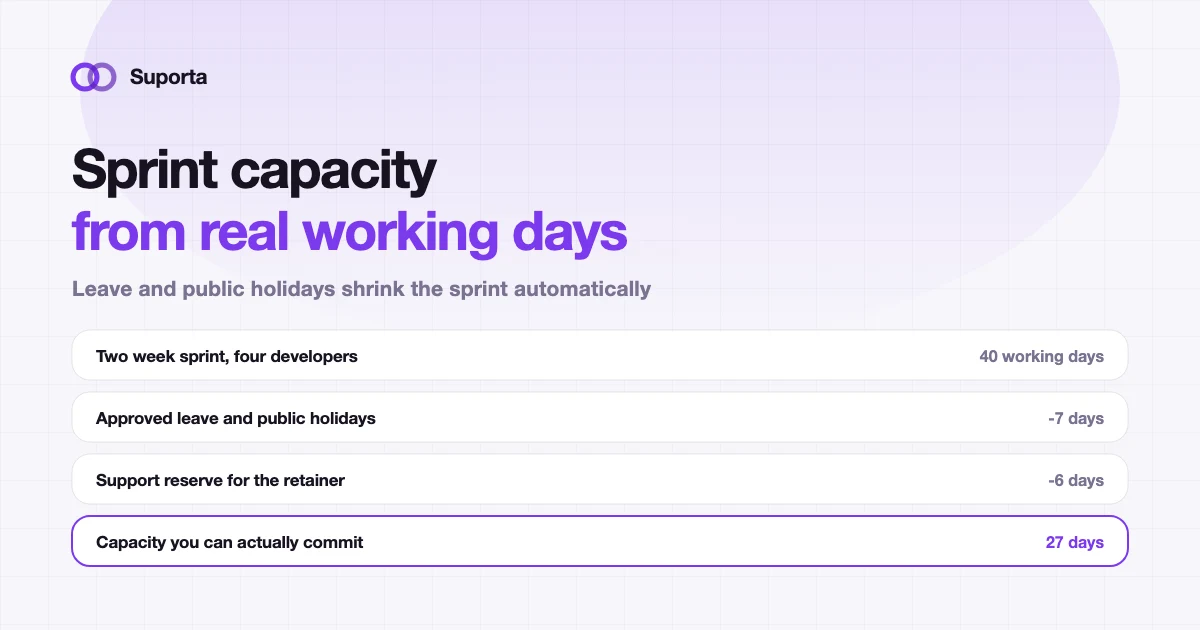
Ask a team how much capacity their next sprint has and you usually get headcount multiplied by days. That number is always wrong, always in the same direction, and the gap is absorbed by the same people every time. This is a practical method for calculating capacity you can actually commit to, and for keeping it honest when leave, support and reality intervene.
Why teams overcommit, sprint after sprint
Overcommitment is rarely optimism about the work. It is arithmetic that starts from availability nobody has.
- Headcount is used as capacity. Four developers, two weeks, forty days. Nobody has forty days.
- Leave is remembered late. Someone mentions a holiday during planning, everyone nods, and the sprint total is not changed.
- Support is unfunded. The retainer tickets that arrive mid-sprint were never in the plan, so they are paid for out of the feature work.
- Yesterday's velocity is used as tomorrow's promise. Velocity is a measurement, not a commitment, and it was measured in a sprint with different people available.
- Part-time is rounded up. Four days a week becomes "basically full time" in the spreadsheet.
The calculation, in five subtractions
Start from the calendar rather than the team size, and subtract in this order. Doing it per developer matters, because averages hide exactly the person who is away.
| Step | Example, 2-week sprint, 4 developers | Running total |
|---|---|---|
| Working days in the sprint per person | 10 days × 4 = 40 | 40 |
| Minus contracted part-time days | One developer works 4 days/week: −2 | 38 |
| Minus public holidays | One holiday in the period: −4 | 34 |
| Minus approved leave | One developer away 5 days, another 2: −7 | 27 |
| Minus support and meeting reserve | 20% for retainer tickets and ceremonies: −5.4 | 21.6 days |
Forty became twenty-two. That is not pessimism, it is the same team described accurately. Teams that plan against the first number and deliver against the second conclude they are slow. They are not slow, they are measured against a fiction.
Story points or hours?
Both, for different questions. Story points are good at relative sizing and terrible at scheduling. Hours are good at scheduling and terrible at estimating unfamiliar work. Agencies need both because they answer to two audiences.
| Question | Use | Why |
|---|---|---|
| Is this bigger than that? | Story points | Relative sizing is fast and reasonably stable across a team |
| Will it fit in this sprint? | Capacity in days | Only time competes with time |
| What do we invoice? | Logged hours | Estimates are not billing data, actuals are |
| Was the estimate any good? | Points versus logged hours | The ratio, over many tickets, is the only honest feedback loop |
The mistake to avoid is converting points to hours with a fixed exchange rate and then defending the conversion. Track the relationship, let it inform the next estimate, and do not promise it to a client.
Reserve capacity for the work you know is coming
Every agency running retainers has a stream of unplannable work: a P1 on Tuesday, a client question that turns into two hours of investigation, a deployment that needs babysitting. You cannot schedule the specific tickets, but you can absolutely predict the volume, because you have months of history.
Take the last three sprints, add up the hours spent on work that was not in the sprint at planning time, and reserve that percentage. Most agencies land somewhere between 15 and 30 percent. Booking it explicitly converts a recurring disruption into a budget line, and it stops the same senior developer from silently absorbing all of it.
Balance the load across people, not just the total
A sprint can be correctly sized in aggregate and still be undeliverable, because the work is stacked on one person. The classic case is the only developer who knows the payment integration, holding six tickets while two colleagues have room.
- Fill per developer against their own capacity, not against the team total.
- Look at who is over before the sprint starts. After the standup on day three is too late.
- Treat a single-person bottleneck as a knowledge risk, and pair on one of those tickets deliberately.
- If a reshuffle suggestion is available, treat it as a proposal to argue with, not an instruction. The tool does not know that one client is about to renegotiate.
Closing a sprint without losing work
Unfinished work at the end of a sprint is normal. Losing it is not. A close flow should roll unfinished tickets forward deliberately, with three decisions made explicitly rather than by default:
- Carry it. Still valid, still next. It keeps its history and moves.
- Re-estimate it. What is left is not what was planned. Change the estimate before it moves, or the next sprint inherits a lie.
- Return it to the backlog. It was not important enough to finish, which is information. Say so, and tell the client if they were expecting it.
Carrying work silently is how a backlog becomes a place tickets go to be forgotten, which is the same failure described in preventing stale tickets.
Does AI change the capacity maths?
Some, and less than the marketing suggests. Agents can take work off the queue — a planner reading the codebase, a coding agent implementing a change, a reviewer running tests — but every run still ends at a pull request that a human reads and merges. The review time is real and it belongs in your capacity.
The honest way to plan for it: keep human review time in the sprint, measure over a few sprints how much implementation time actually moved, and adjust from evidence. We wrote about the boundary in AI coding agents for software teams.
Sprint planning checklist
- check_circleCapacity starts from working days in the period, per person
- check_circleApproved leave and public holidays are subtracted automatically, not from memory
- check_circlePart-time contracts are reflected exactly, not rounded up
- check_circleA support reserve is booked, sized from the last three sprints
- check_circleEach developer is filled against their own capacity
- check_circleThe sprint total is compared to last sprint's delivered, not last sprint's planned
- check_circleClosing the sprint forces a carry, re-estimate or return decision per ticket
Related articles
All articles arrow_forward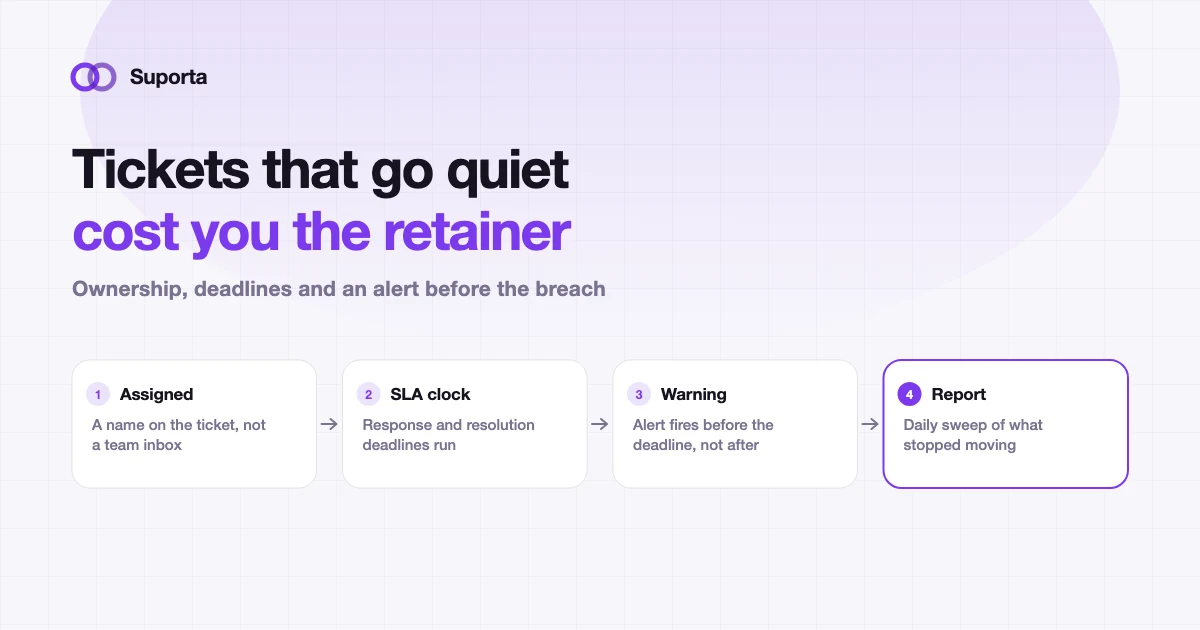
How to Prevent Client Support Tickets From Going Stale
Nobody decides to ignore a ticket. It gets assigned on Tuesday, is genuinely lower priority than the thing on fire, and by the following Monday the client has escalated.
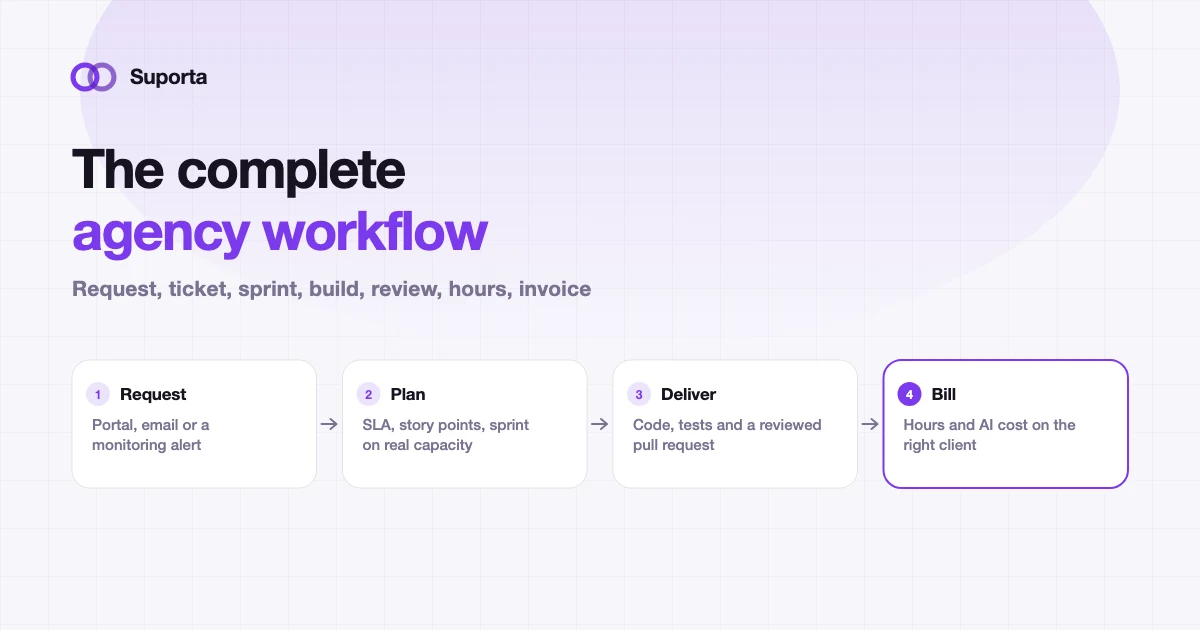
The Complete Software Agency Workflow: Ticket, Sprint, Development, Testing and Billing
Ten stages, and the value is in the joins rather than the stages. This is the reference we use ourselves, including what goes wrong at each handover and how to tell.
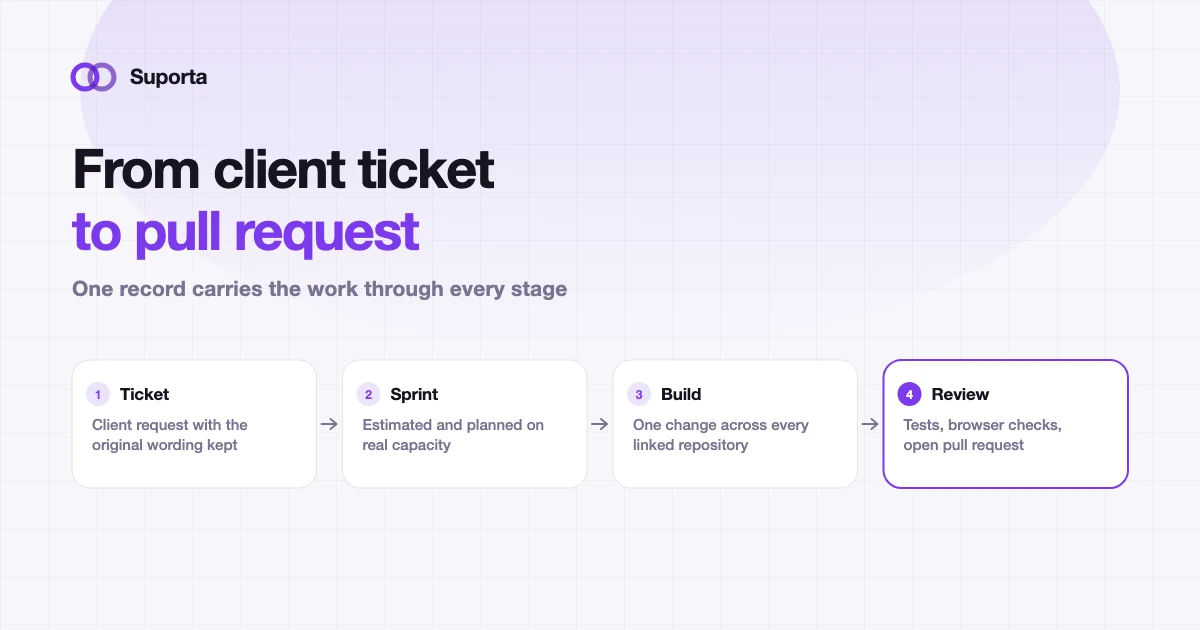
Helpdesk for Software Agencies: From Client Ticket to Pull Request
A generic helpdesk closes when someone replies. An agency ticket closes when code is merged, tested and billed. That gap is where most agency admin time disappears.