
Helpdesk for Software Agencies: From Client Ticket to Pull Request
A generic helpdesk is built around one assumption: a ticket is answered, then closed. In a software agency the answer is the beginning. The ticket becomes an estimate, a sprint item, a branch, a pull request, a set of logged hours and eventually an invoice line. This article walks through where that chain usually breaks, and what a helpdesk built for development work has to connect.
Why generic helpdesks stop too early
Classic helpdesk software comes from customer service: a question arrives, an agent answers it, a satisfaction score is collected. The unit of work is the conversation, and the definition of done is "the client stopped asking".
A development agency inherits a different unit of work. "The login page returns a 500 on an invalid email" is not a conversation. It is a defect that needs reproducing, estimating, scheduling against someone's actual availability, implementing across possibly several repositories, testing, reviewing, merging, deploying and billing. A helpdesk that considers the ticket finished when a reply is sent is measuring the first two percent of the job.
That mismatch does not show up as a missing feature. It shows up as a second system. The team adds a project tool for the development side, and now every ticket exists twice.
The copy-paste tax nobody budgets for
The cost of a disconnected helpdesk is rarely a licence fee. It is the manual synchronisation that keeps two systems telling the same story, performed by the most expensive people in the building.
| Moment | What is copied by hand | What goes wrong |
|---|---|---|
| Intake | Client email is rewritten as a development task | Context, screenshots and the original wording are lost |
| Planning | Task is re-estimated in the project tool | The estimate on the ticket and the estimate in the sprint disagree |
| In progress | Status is updated in two places | One of them is always stale, usually the one the client can see |
| Delivery | Pull request link is pasted into the ticket | Only if someone remembers, which is why nobody trusts the ticket |
| Billing | Hours are pulled from a third tool into a spreadsheet | Work gets billed twice or not at all |
Each row looks like thirty seconds. Multiply by a few hundred tickets a month across a dozen client retainers and you have a part-time job that produces nothing a client would pay for. We wrote about the wider version of this problem in managing multiple clients without tool sprawl.
What "ticket to pull request" means in practice
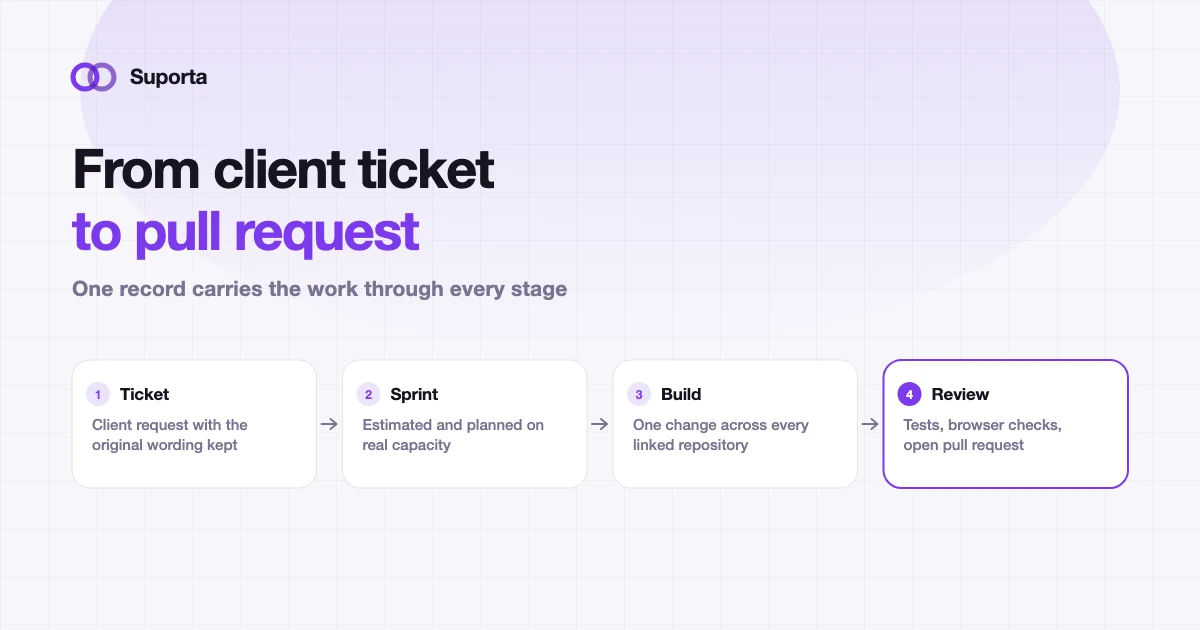
An integrated workflow does not mean a helpdesk with a Git logo on the marketing page. It means the same record carries the work through every stage, and each stage adds to it rather than duplicating it.
One record, seven stages
- IntakeThe request arrives from the client portal, an email through the Outlook add-in, or a Sentry issue. The original wording is kept.
- ElaborationA two-line complaint is turned into a developer-readable ticket with reproduction steps and acceptance criteria, the original text still attached.
- Estimation and planningStory points are suggested, the ticket is placed in a sprint against real developer capacity rather than a wish.
- ImplementationA developer, or an agent under supervision, works across every repository the project links, on a branch tied to the ticket.
- VerificationTests run, the application is booted and checked, and failures go back into the same ticket instead of a side channel.
- Review and mergeA pull request is opened with the checks it passed spelled out. A human presses merge.
- Time and billingHours logged against the ticket roll up to the client and project, ready to invoice.
The important property is not automation. It is that there is exactly one place where the truth about this piece of work lives, and every role looks at the same one. The client sees the status they are allowed to see. The developer sees the branch. The account manager sees the hours.
The four connections that actually matter
You do not need every module in one product. You need four specific joins, because these are the ones that cost money when they are missing.
1. Ticket to SLA
A support ticket without a deadline is a suggestion. Ticket and SLA handling means priorities with real response and resolution deadlines, alerts before a breach rather than after, and a report of what is going quiet. The failure mode here is the ticket that is assigned on Tuesday and rediscovered the following Monday, which is common enough that we gave it its own article.
2. Ticket to sprint capacity
Scheduling work against a team's theoretical capacity is how agencies end up committing to sprints that were never physically possible. Capacity has to come from actual working days minus approved leave and public holidays, per developer. When someone books a week off in August, the August sprint should shrink by itself. That is the whole argument of sprint capacity planning.
3. Ticket to code
A project is rarely one repository. It is an API, an admin front end, sometimes a mobile client. If the ticket links to the repositories the project spans, a change can be planned as one problem and delivered as one pull request per repository that actually changed, all traceable back to the request that caused it.
4. Ticket to invoice
Hours logged against a ticket already know which client and which project they belong to. That is the difference between invoicing from data and invoicing from memory. If your timesheet lives in a spreadsheet that nobody reconciles with the ticket list, you are almost certainly under-billing. See tracking billable hours per client for the mechanics.
Where AI agents fit, and where they do not
Once the ticket carries real context, parts of the chain can be handled by AI agents: reading the codebase and proposing an approach, implementing a change across repositories, running the test suite and checking the result in a browser. Suporta's agents do exactly that, and hand back a pull request.
What they do not do is merge. Every run ends with an open pull request and a written record of the checks that ran, and anything requiring judgement lands in a queue for a human. That constraint is deliberate: an agency is contractually responsible for the code it ships, and "the agent decided it was fine" is not a defence. We go into the reasoning in AI coding agents for software teams.
How to evaluate a helpdesk as a software agency
Most helpdesk feature comparisons are written for customer service teams, so they compare the wrong things. These are the questions that separate a support inbox from a delivery system.
Evaluation checklist
- check_circleCan a ticket carry an estimate, a sprint and a repository, or does that live somewhere else?
- check_circleDoes sprint capacity account for approved leave automatically, or is it a number someone types in?
- check_circleCan time be logged on the ticket itself, by the person doing the work, at the moment they do it?
- check_circleDo client users see only their own organisation's tickets, enforced on the server rather than hidden in the interface?
- check_circleCan you separate an internal note from a client-visible reply without a second thought?
- check_circleDoes closing a sprint roll unfinished work forward, or does someone rebuild the board by hand?
- check_circleCan you answer "what did this client cost us this month" including development hours and, if you use them, AI costs?
- check_circleIf AI agents are involved, can you see the cost per ticket and cap it?
Where to start if you already have two systems
Nobody migrates a working agency in a weekend, and you should not try. A sane order of operations:
- Start with one client retainer, ideally an active one with a steady flow of small tickets. A quiet client will not surface the friction you are trying to remove.
- Move intake first. Whichever system receives the client request should be the system that owns the ticket. Everything else follows from that.
- Move time logging second. It is the fastest measurable win, because it changes an invoice rather than a process.
- Only then connect the code. Repositories, branches, pull requests and, if you want them, agents.
- Compare one month. Hours billed, tickets closed, and how long a ticket sat before someone touched it.
The end state is unglamorous and very valuable: a client writes an email, and everything that happens next — the estimate, the sprint slot, the branch, the review, the hours, the invoice line and the Friday summary the client receives — hangs off that one record. That is the whole point of the end-to-end agency workflow.
Related articles
All articles arrow_forward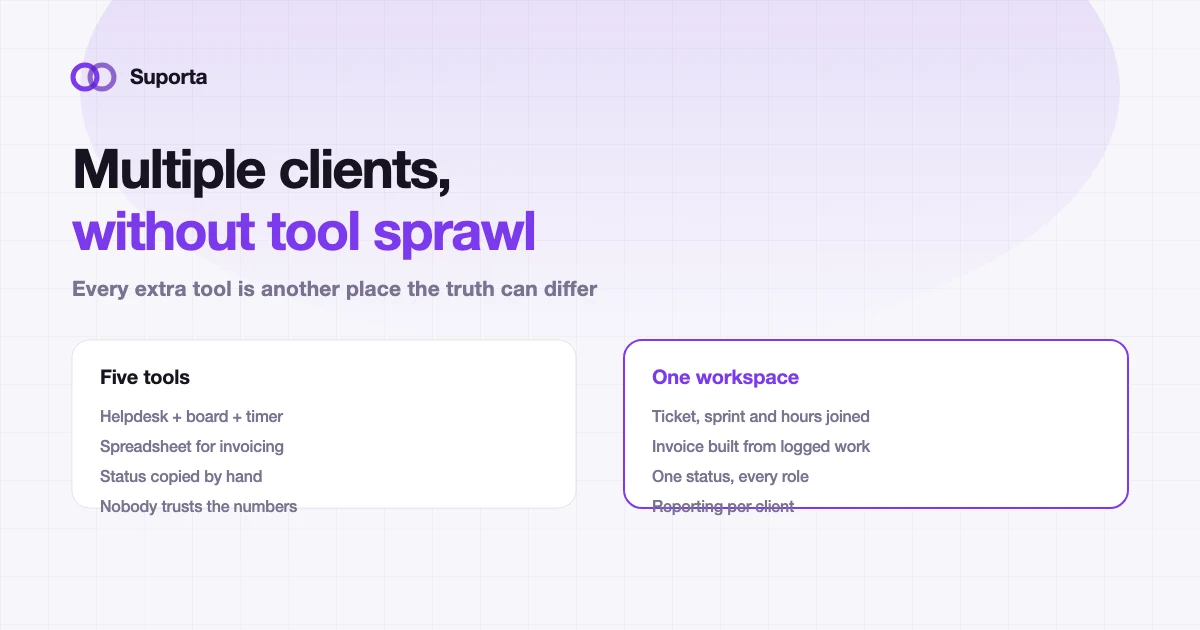
How Software Agencies Can Manage Multiple Clients Without Tool Sprawl
The problem is rarely the number of tools. It is that each one holds a different version of the same client, and keeping them agreeing is a full-time job nobody was hired for.
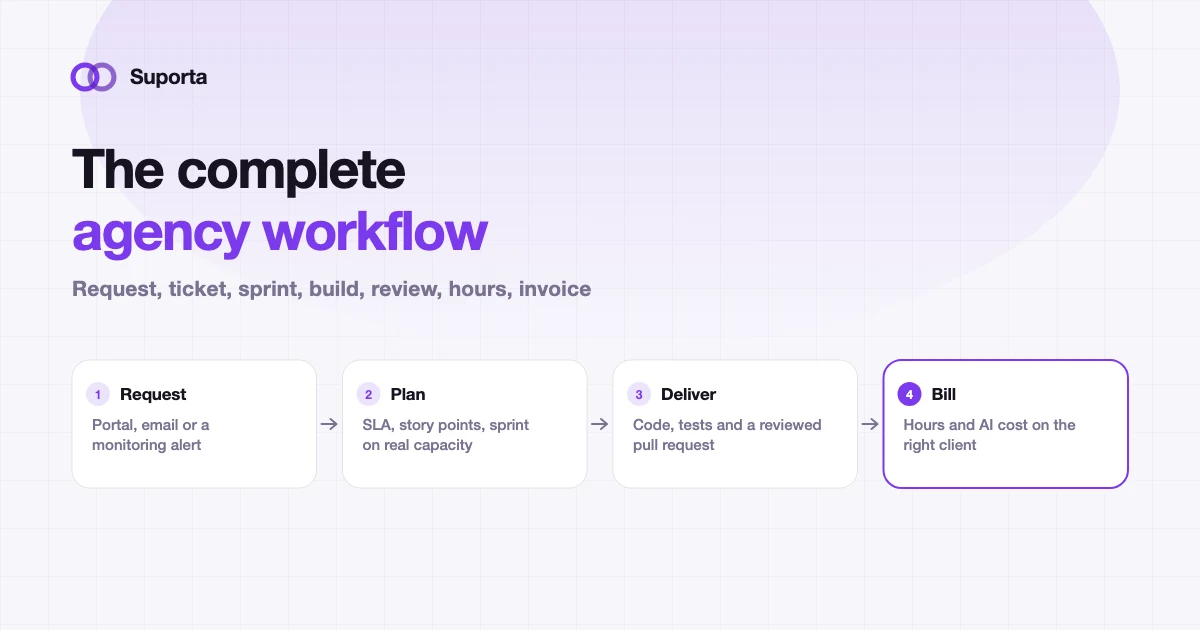
The Complete Software Agency Workflow: Ticket, Sprint, Development, Testing and Billing
Ten stages, and the value is in the joins rather than the stages. This is the reference we use ourselves, including what goes wrong at each handover and how to tell.
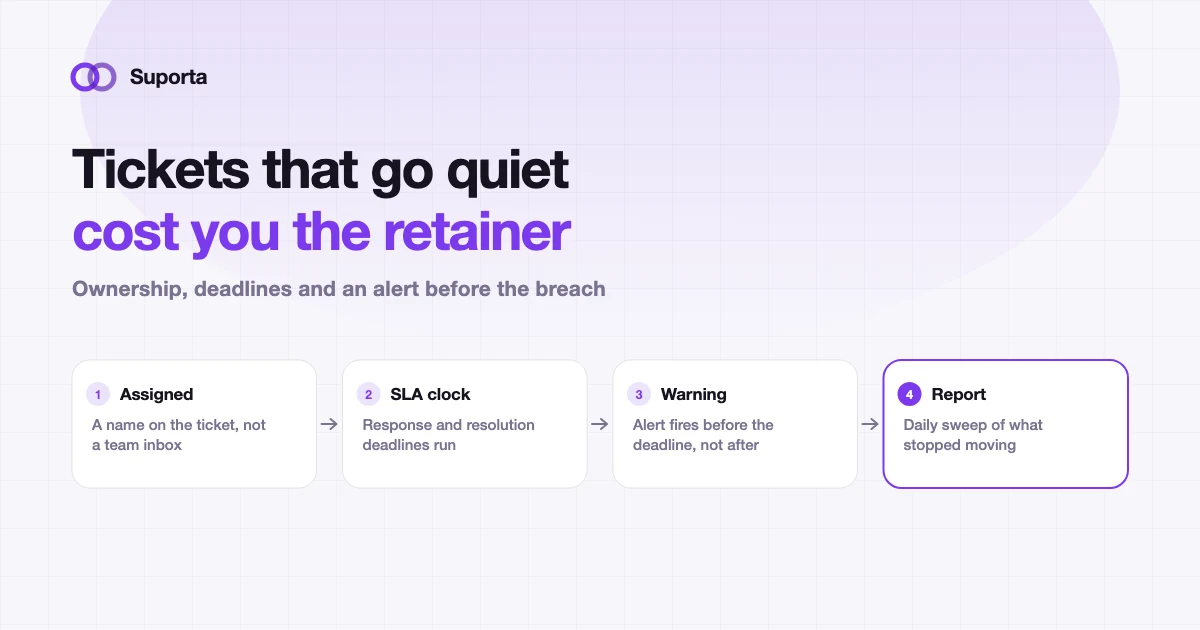
How to Prevent Client Support Tickets From Going Stale
Nobody decides to ignore a ticket. It gets assigned on Tuesday, is genuinely lower priority than the thing on fire, and by the following Monday the client has escalated.